
Molfetta, 21/02/2026
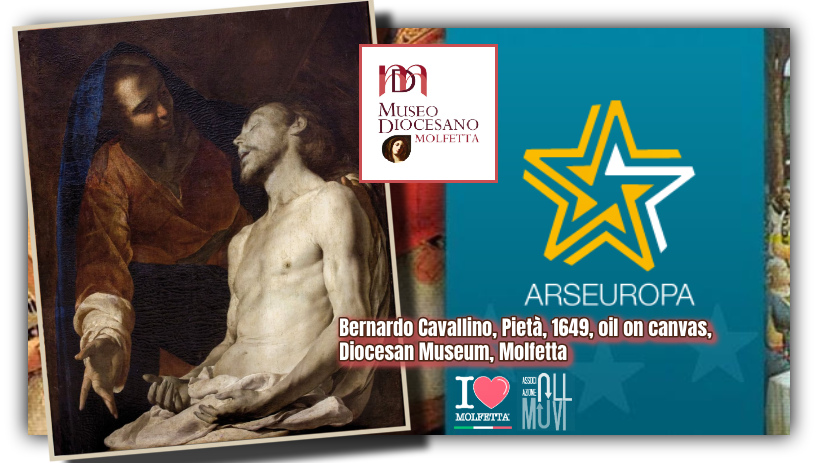
Bernardo Cavallino, Pietà, 1649, oil on canvas, Diocesan Museum, Molfetta.
The canvas comes from the church of Santa Maria Consolatrice degli Afflitti [also known as the Church of Purgatory] in Molfetta and dates to the painter's final years, likely 1649, the date of construction of the chapel, where it was placed on the cornice of the altar of the patronage of Lupis, located in the left transept.
Experts consider the work to be one of the Neapolitan painter's masterpieces. The Pietà is signed, like only ten others by the artist, who produced approximately eighty works. The canvas, painted by Cavallino, is believed to be the iconographic development of the Imago Pietatis, or the Man of Sorrows, which underwent some changes in its syntactic structure as it spread throughout the West.
Between Christ and the cross, which blends into the brown background and symbolizes passion and sacrifice, stands the Mother, with common features, wearing a white undergarment and a red robe, and a blue veil on her head. The white of the undergarment is the colour of grace and purity. The red of the robe symbolizes humanity, the Son of God whom Mary bore within herself; the blue, the colour of the veil, symbolizes divine nature.
The Mother's face, turned toward her Son, expresses more than pain, wonder and adoration, in the act of tenderly embracing her Son and entering into dialogue with Him. The Pietà is therefore the image of the Groom who is with the bride, of Christ who is with the Church, of which Mary is the image.
The interpretation could lie precisely in the gesture of Mary's right hand, perhaps intended to indicate the number three with her fingers.
news source on ars.europa
Bernardo Cavallino, Pietà, 1649, olio su tela, Museo Diocesano, Molfetta.
La tela proviene dalla chiesa di Santa Maria Consolatrice degli Afflitti [detta anche del Purgatorio] in Molfetta ed è da collocarsi negli ultimi anni di attività del pittore, probabilmente nel 1649, data di costruzione nella cappella, dove essa era collocata nella cimasa dell’altare di patronato Lupis, posto nel transetto sinistro.
L’opera è ritenuta dagli esperti uno dei capolavori del pittore partenopeo. Il dipinto della Pietà è firmato come soli altri dieci realizzati dall’artista, il quale vanta una produzione di circa ottanta opere. La tela, realizzata dal Cavallino, sarebbe lo sviluppo iconografico dell’Imago pietatis, ovvero l’Uomo dei dolori, che nella sua diffusione in Occidente subisce alcuni mutamenti di struttura sintattica.
Tra il Cristo e la croce, che si confonde con il colore bruno del fondo e che è simbolo della passione e del sacrificio, si interpone la Madre, dai lineamenti popolani, cinta da una sottoveste bianca e da una veste rossa, e sul capo un velo azzurro.
Il bianco della sottoveste è il colore della grazia e della purezza. Il rosso della veste è simbolo dell’umano, del Figlio di Dio che Maria ha portato in sè; l’azzurro, il colore del velo, è simbolo della natura divina. Il volto della Madre, rivolto verso il Figlio, più che dolore esprime stupore e adorazione, nell’atto di abbracciare con tenerezza il Figlio e di porsi in colloquio con Lui.
La Pietà è dunque, l’immagine dello Sposo che è con la sposa, di Cristo che è con la Chiesa, di cui Maria è l’immagine. L’interpretazione potrebbe risiedere proprio nel gesto della mano destra di Maria, forse orientato ad accennare il numero tre con le dita.
fonte Museo Diocesano Molfetta facebook profile Clicca qui
#weareinmolfetta #museodiocesanomolfettese #ilovemolfetta #tiportoinpuglia #nicetomeetyoupuglia #coopFeArt #associazioneollmuvi #doyouknowpuglia #flytopuglia
Riproduzione riservata. La riproduzione è concessa solo citando la fonte con link alla news.